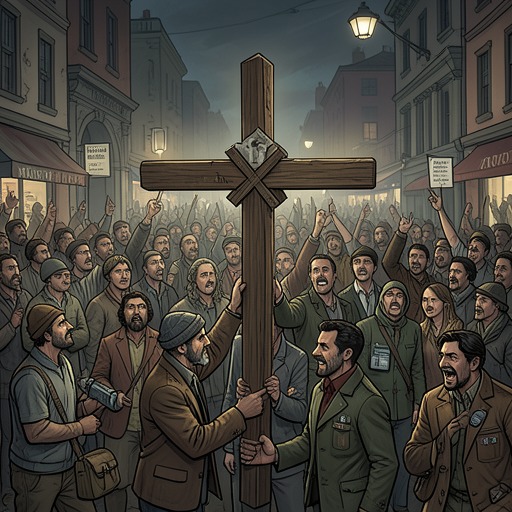
Bigger rejects the preacher’s cross
Native SonBigger Thomas rejects the preacher’s cross in the Cook County Jail after a burning Ku Klux Klan cross has transformed the symbol of Christian salvation into, for him, a sign of racial hatred and danger. His rejection is both a refusal of religious consolation and a response to a perceived betrayal: he had begun to entertain hope, but now regards the cross at his throat as inseparable from the threat outside. The episode ends not in reconciliation but in an isolated resolve to trust no one, including Jan Erlone and Max.
Setting and the Cross’s Reversal
The episode follows Bigger’s transport through crowded streets to the Cook County Jail. Seated between two policemen, he keeps looking toward the burning cross he has just seen. The cross around his neck, given to him by the preacher, presses against his chest; the juxtaposition makes a promise of salvation feel to him like a threat. He understands the burning emblem as the Ku Klux Klan’s declaration of hatred, not as the cross of Christ. The same religious sign therefore carries two incompatible meanings: the preacher’s hope and the Klan’s racial terror.
That collision sharpens a change already underway. The preacher had prayed over Bigger earlier that day, and Bigger had allowed himself to feel that something might still happen. Now he interprets that openness as having left him vulnerable to disappointment. The cross is no longer a source of comfort he can separate from the violence around it. By the time the officers bring him to his cell, he wants it off his body, and he regards keeping it as dangerous rather than reassuring.
Rejection and Confrontation
Once inside the cell, Bigger tears open his shirt, removes the cross, and throws it away. His action makes the refusal physical and public: he does not merely decline the preacher’s counsel but rejects the object attached to it. When the men tell him to keep the cross, he insists that he can die without one. Their appeal to God does not persuade him; he answers that he has no soul. The exchange establishes the distance between the men’s religious understanding of his situation and Bigger’s own refusal to accept it.
The men leave the cross just inside the cell door, but Bigger picks it up and throws it away again. When Reverend Hammond approaches with another man, Bigger recognizes the preacher who prayed over him and tells him to leave. He rejects an offer of prayer as well as the object, directing the preacher to take his religion with him. His response makes clear that the dispute is not about possession of a small keepsake alone: he refuses the consolation and authority that the cross represents to him in this moment.
The guard attributes Bigger’s refusal to the influence of the Reds, but Bigger vehemently denies that explanation. He threatens violence if the preacher enters. As Reverend Hammond quietly retrieves the cross, the guard unlocks the cell; Bigger grabs the bars and drives the door shut against the preacher. The sequence turns an argument into a physical boundary. Bigger uses the cell door to stop the attempted approach, and Reverend Hammond withdraws, leaving the cross behind once more.
Aftermath and Withdrawal
After the preacher and guard leave, Bigger again picks up the cross and throws it through the bars. The repeated rejection matters: no one has forced him to keep the object, yet its return to the cell does not restore its former meaning. Each time it is placed within reach, he casts it away. He then reflects that he does not want to feel hope again, because he now connects the possibility of hope with the cross that seemed to promise protection and then became, in his experience, a sign of danger.
The episode also records Bigger’s awareness of the jail’s racial separation. As his emotional intensity subsides, he notices that Black and white prisoners are assigned to different cell blocks. The narration presents this recognition as an ordinary fact registered without bitterness, not as a new confrontation. Even inside the institution holding him, racial division remains part of the surroundings. His attention to that separation places his personal crisis within the larger system that has shaped his sense of threat and confinement.
Significance in Bigger’s Arc
Bigger’s rejection marks a turn away from the religious hope offered to him and toward a severe form of self-reliance. He decides that whatever he thinks or does must come from himself alone, or not at all. The resolve extends beyond Reverend Hammond: he includes Jan Erlone and Max among those he will no longer trust, even while acknowledging that they may be well-intentioned. The episode thus links the dismissal of the cross to a broader refusal of dependence on other people.
The scene also makes the cross a contested object rather than a stable emblem of comfort. Its religious meaning cannot protect Bigger from the Klan’s threat, and, after the burning cross, the preacher’s gift appears to him as a promise betrayed. His decision to discard it does not settle the tension between salvation and racial violence; it exposes how little reassurance religious language can offer him at this point. The final image of the cross thrown beyond the bars leaves Bigger alone with his resolve, while the segregated jail remains the material world in which that resolve takes shape.